Download Ebook Computational Physics (2nd Edition)
Now, in this manner could not have to happen. You could go forward in better life with variant sorts of resources. Schedule as an excellent source can be accepted to make use of. Publication is a way to bring and also check out when you have the time to get it. Even you don't such as reviewing a lot; it will actually help you to comprehend few of the new expertise. And also right here, Computational Physics (2nd Edition) is given ahead forward along your ways.
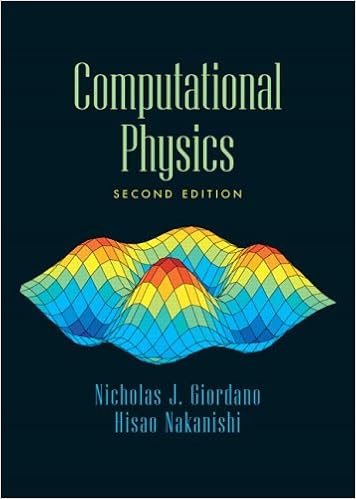
Computational Physics (2nd Edition)

Download Ebook Computational Physics (2nd Edition)
Computational Physics (2nd Edition). A job might obligate you to consistently improve the knowledge and also encounter. When you have no enough time to boost it straight, you could obtain the encounter and also knowledge from reading guide. As everyone knows, publication Computational Physics (2nd Edition) is popular as the window to open the world. It means that checking out publication Computational Physics (2nd Edition) will provide you a brand-new way to discover everything that you need. As guide that we will certainly provide right here, Computational Physics (2nd Edition)
When going to take the experience or ideas types others, book Computational Physics (2nd Edition) can be a great resource. It's true. You can read this Computational Physics (2nd Edition) as the source that can be downloaded right here. The way to download and install is likewise simple. You can go to the web link web page that we provide then acquire guide to make a deal. Download and install Computational Physics (2nd Edition) and you could put aside in your personal gadget.
So, this is what this publication uses to you. You may take no notice of this information concerning Computational Physics (2nd Edition) Ignoring the advantages of this publication will companion you to regret. Yeah, the advantages of reading this book will be same with others. Improving the experience, expertise, as well as motivations are the basic means of you to read some books. Yet, the in addition, the advantages will certainly be shown from each book when analysis and completing it.
Why should be this on the internet book Computational Physics (2nd Edition) You might not have to go someplace to review the publications. You can review this e-book Computational Physics (2nd Edition) each time and also every where you want. Also it is in our spare time or feeling bored of the tasks in the office, this is right for you. Obtain this Computational Physics (2nd Edition) now and also be the quickest person that completes reading this publication Computational Physics (2nd Edition)
About the Author
Nicholas Giordano obtained his B.S. at Purdue University and his Ph.D. at Yale University. He has been on the faculty at Purdue since 1979, served as an Assistant Dean of Science from 2000-2003, and is currently the Hubert James Distinguished Professor of Physics. His research interests include electrical conduction, superconductivity, and magnetism in ultra-small metallic structures, along with musical acoustics and the physics of the piano. Ideas for this book grew out of the course on computational physics that he developed and taught in the early 1990s. Professor Giordano earned a Computational Science Education Award from the Department of Energy in 1997, and in 2004 was named Indiana Professor of the Year by the Carnegie Foundation for the Advancement of Teaching and the Council for the Advancement and Support of Education. Hisao Nakanishi earned his B.S. from Brown University and his Ph.D. from Harvard University. His Ph.D. research concerned scaling and universality in a geometric phase transition called percolation and he has been interested in scale-invariance ever since. During his first postdoctoral work at Cornell he was introduced to the problem of surface critical phenomena such as wetting phase transitions, and later at the University of California, Santa Barbara, he started working on the statistics of diffusion and polymers in earnest. .In 1992 Professor Nakanishi was a part of the team that won a Gordon Bell Prize for the application of parallel computing to a problem in polymer statistics. More recently he has also put on another hat as a developer of a computer-based interactive exercise system which is used by a few thousand students at Purdue each year.
Read more
Product details
Hardcover: 568 pages
Publisher: Pearson; 2 edition (July 31, 2005)
Language: English
ISBN-10: 0131469908
ISBN-13: 978-0131469907
Product Dimensions:
7.4 x 1.4 x 9.6 inches
Shipping Weight: 2 pounds (View shipping rates and policies)
Average Customer Review:
4.5 out of 5 stars
9 customer reviews
Amazon Best Sellers Rank:
#130,575 in Books (See Top 100 in Books)
Ok this book is good, it conveys lessons that novice programmers can understand. My only problem with it was that it was my textbook for college where we were instructed to use Matlab on homework problems where this text uses Fortran to show examples. If you know Fortran then go for it, if not, then it would be best to look somewhere else. There are plenty of Computational Physics texts that use different programming languages that one could be familiar with.
A good guide in learning how to apply computational physics to various problems.
It is a great introduction, but some explanations to the topic are unclear or murky
Let me begin by saying that I have read through many books on computational physics and this is by far the one that I prefer. It seems suitable for use in a classroom or for self study. The writing style is clear, almost conversational and new concepts are developed carefully and can be easily understood.The unfortunate part of the book is of course the use of Basic for the examples. I agree with the author that this language, and especially the version used, is suitable and even easy to use for the subject at hand, however it is not an industry standard language.I would much rather see C, C++ or even Python used for the examples. It is not hard to translate from the Basic versions, but many readers of this book will be scientists, but not generally computer scientists. And they may be learning to program as they are using this book. If the examples were written using basic C syntax, the reader would be well on his way to learning not only computational physics, but a widely used language as well.With this light criticism, I really like the book and have not found anything that I would prefer regardless of the programming language used.
This book is straightforward and enjoyable. Takes 'theory' for messy real world problems and makes it practical with rather simple methods.
The book came in better time and better repair than I had expected. Cover and pages near-new, arrived on the first day of the predicted time (like 4 days or something). I would recommend to anyone who's found a good deal through them.
I'm glad I bought this book. I was hesitant at first, while perusing it in the bookstore, because it seemed to be aimed at an audience that is, well, too undergraduate. However the book gets directly to the essence of the algorithms used to carry out simulations: nothing extraneous. Within an hour after sitting down to read a chapter, one can often have the first working code finished. It is through trying simulations, playing with parameters, and seeing what happens that one starts to get a feel for the models which are otherwise just differential equations on paper. The style of exposition is informal and lively. The range of subjects covered is diverse. It presumes the reader is familiar with physics of the models discussed, yet each chapter begins with a short review. The book is organized in a way that permits skipping around, which I like, and I found that the exercises are packed with suggestions and new things to try. All in all it is a very good book for someone who may know next to nothing about a particular physics model and wants to learn it though computer simulation.Since the publisher doesn't include the "search inside" feature, here is a list of chapter headings:First numerical problems. Realistic Projectile Motion. Oscillatory Motion and Chaos. The Solar System. Potentials and Fields. Waves. Random Systems. Statistical Mechanics, Phase Transitions, and the Ising Model. Molecular Dynamics. Quantum Mechanics. Vibrations, Waves, and the Physics of Musical Instruments. Interdisciplinary Topics: Protein Folding, Earthquakes, Neural Networks and the Brain, Real Neurons and Actions Potentials, Cellular Automata.
I have found this book to be an outstanding resource for teaching computational physics. As others have noted, the emphasis on this book is generally on the physics with less emphasis on the methods, but enough to usefully reproduce what they have done. I am not sure how it would work as a textbook for the students and, indeed, I have not tried to use it in this way. Certainly, at least in an undergraduate course, it would need to be supplemented by more discussion of numerical methods.
Computational Physics (2nd Edition) PDF
Computational Physics (2nd Edition) EPub
Computational Physics (2nd Edition) Doc
Computational Physics (2nd Edition) iBooks
Computational Physics (2nd Edition) rtf
Computational Physics (2nd Edition) Mobipocket
Computational Physics (2nd Edition) Kindle
0 komentar:
Posting Komentar